



This title is a chapter from a memoir I'm writing about my life as a carpenter—the experiences that inspired mycarpentry.com. While mycarpentry.com is about carpentry, these chapters are about the carpenter.
China Coast
Tampa, Florida (Spring, 1995)
Building the China Coast Restaurant was one of the most challenging experiences of my life. I was the foreman in charge of 15 carpenters. My job was to ensure the restaurant was constructed as specified in the blueprints, on time, and under budget. But things don't always work out as you plan.
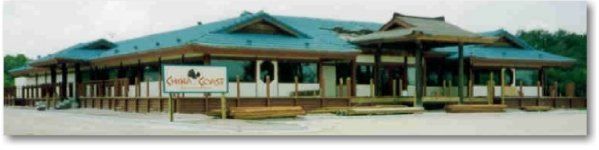
Six months earlier, I was sitting at home in my Corpus Christi apartment, unemployed, writing a computer program that I hoped would someday be a new source of income, when I received a call from Erdol, my best friend from Turkey.
"Hi Matt. I just noticed that there are some construction workers building a new restaurant next to my coffee shop. They might be looking for carpenters."
"Thanks for the tip, Erdol! I am on my way!"
I didn't waste any time following up on Erdol's tip - carpentry jobs were scarce in South Texas. Before Erdol and Marcy opened their coffee shop, he and I were laying carpet for a living.
As I took the Staples exit from South Padre Island Drive, I noticed, on the side of the road, a full sheet of plywood leaning against a utility pole with Carpenters Wanted spray-painted on it. Erdol was right! I pulled into the job site parking lot and walked toward two men standing on a two-day-old concrete foundation.
"Are you the foreman?" I asked, looking at both of them.
"Yes. I'm Daryl and this is Mark, one of our top carpenters. Are you looking for work?" replied the taller fellow.
"You bet!" I said.
After a short interview, Daryl hired me on the spot. An hour later, I was happy, employed, and building a Chinese restaurant in the afternoon sun.
Daryl was a Christian preacher who knew a great deal about carpentry and construction. He was not like any other construction foreman I had ever known. He was sharp-witted and benevolent, and treated the crew with dignity. After a few weeks, our team had grown to eight carpenters and three helpers. Everyone had tremendous respect for Daryl, and he deserved it.
The crew consisted of various highly-skilled carpenters that, by chance, also specialized in some diverse unrelated field of expertise - there was Daryl, the preacher; Dave, the military guy (he was an officer in the Coast Guard in between assignments); Ben, a retired Reynolds Aluminum factory worker; Don, the Hill Country "cowboy"; and as for me, I was just a carpenter with a fascination for programming and computers. We all looked forward to going to work each day and felt lucky to have stumbled across the plywood sign that brought us all together.
There was also Larry, our boss, the "country boy" from Georgia, who, even after three months on the job, none of us had ever met. He was the owner of Homesite Construction (the company we all worked for) and was simultaneously building another China Coast in Dayton, Ohio.
After a few weeks, Larry asked Daryl to send two carpenters to Ohio to help finish his job. Daryl looked at me and smiled, "Our boss needs us in Dayton." Daryl was excited about the idea of a road trip, but I was concerned about leaving my wife alone in Corpus for too long. Daryl and Larry promised me the work would only take three or four days, so I agreed to help them. Daryl left Mark in charge of the China Coast in Corpus Christi, and on January 15th, Daryl and I flew north to Ohio.
Our flight to Dayton included a two-hour layover in Cleveland. When we arrived, Daryl and I found a bar where we could slurp a few beers and pass the time while waiting for our flight to Dayton. On the TV above the bar, the Cowboys were playing the 49ers at Candlestick Park. I was surprised to find so many Cowboys and 49ers fans at the Cleveland airport (the fans were likely travelers from elsewhere - I doubt the locals would have cared much for either team). Before the game was over (stinking Cowboys), we boarded a small commuter plane to Dayton.
Larry met us at the airport.
"Jehovah!" Daryl hollered when he spotted Larry in the crowded airport.
"Knock it off, Daryl," Larry said as he got closer.
Daryl laughed and said, "Hey Larry, I want you to meet Matt, our carpenter from Corpus, whose skills far exceed those of your average craftsman."
"Hey Matt. I have heard lots of good things about you. Thanks for coming all the way to Dayton to help us out," Larry said.
"No problem, Larry. It is good to finally meet you too."
"Are you guys hungry?" Larry said. "Let's go someplace where we can get a burger and a beer and play some pool."
"Burgers and beer sounds mighty good to me," I said.
Daryl agreed.
We drank beer and played pool until almost midnight, then checked into the hotel where Larry and Shane were registered.
I had been a clean-shaven fellow, but told Daryl and Larry I was not planning to shave the entire time I was in Dayton. If they needed me longer than promised, they would see the evidence of time passed growing on my face.
China Coast, Dayton, Ohio
The Dayton China Coast restaurant was nearly complete - it was about a month ahead of Corpus, but needed many small things fixed before Larry could get his final payment. Shane, Larry's only carpenter in Dayton, was busy working on the punch list when Daryl and I arrived. Shane was a long-blonde-haired, quality-minded carpenter in his early twenties from Houston, Texas, who had been working for Larry for about six months.
Read more/less...
It was unseasonably warm in Ohio, especially for January. I wore jeans and a T-shirt the first few days, but the temperatures trended cooler as time wore on. The job stretched past the four-day promise, as I suspected it would, but after two long weeks, we finished Dayton's new China Coast Restaurant. A strong cold front blew in on our last day on the job and dropped a foot of snow before sunset.
The next day, in the snow, Daryl, Shane, and I packed up Larry's 3/4 ton pickup truck with our tools, luggage, and coffee pot thrown on top, and the four of us began our 1300-mile journey from Ohio back to Texas. About 10 miles south of Cincinnati, we hit an enormous pothole. "I hope we didn't lose the coffee pot on that last bump!" I hollered. "Not a chance," Daryl said, "I saw IT go before we left Dayton." Daryl and I laughed hard. Larry didn't.
We drove straight through, stopping only for gas and food. We arrived in Corpus Christi around noon the next day. We were beat! When I got home, I went immediately to bed without shaving my two-week beard. When my wife got home from work and saw my beard, she liked it. I trimmed it into a goatee and have worn it ever since.
It felt great to be back in the warm South Texas sun. The crew was happy to see Daryl and me back on the job and was eager to hear the details of our Ohio adventure. We discovered Mark had unexpectedly quit and gone home to Houston a few days after Daryl and I flew to Dayton. That was strange, if not irresponsible, but I wasn't surprised. Something was up with Mark - problems at home perhaps - he never said anything, and I never asked. After Mark left, Dave and Ben kept the crew going, and the project was on schedule.
Three weeks later, the Corpus job was over. One of the saddest phases of a construction project is the last day - the job always ends. Our fine team of carpenters wished each other well, said our long goodbyes, and left the job site for the last time. After the crew departed, Daryl informed me that Larry had recently made a deal to build another China Coast in Tampa, Florida, and was looking for a foreman to run it. Daryl declined the offer so he could return to theological studies, but he recommended me for the position. I was nervous about taking on such a big project, but Daryl gave me the confidence I needed: "You can do it. You know as much about building this restaurant as I do." Without intending to, Daryl taught me a great deal about leadership. In the short time we worked together, he and I became good friends. But after that day, we went our separate ways and never spoke again.
Larry offered me the foreman job. I was apprehensive about driving 1200 miles for work, but I thought the experience would be worth it. My wife and I could visit Disney World while we were in the area, and I could make enough money to escape the employment uncertainties of Corpus Christi and move to central Texas, where jobs were plentiful and diverse.
Tammy was excited about the Tampa prospect. That night, we made a list of essential items we would need to take to Florida to get us through the six-month stay (1 pot; 1 skillet; 2 plates; 2 forks; 2 spoons; coffee maker, TV, etc.). We packed the essentials into the camper shell I had just purchased for my Toyota pickup and stored the non-essentials. The next day, we moved out of our Corpus Christi apartment and headed to Houston, where Tammy would stay with her mother and sister until I found an apartment in Tampa.
Tampa Bound
A few days later, Larry, Shane, Mark (rehired by Larry), and I left Houston on a Monday at 5:00 am to begin our 17-hour drive to Tampa. We drove until dark, stopped at a restaurant off of I-10 east of Pensacola for pizza and beer, and checked into a hotel for the night. We woke early on Tuesday morning, had a fast-food breakfast, and continued our journey.
We arrived in Tampa around 2 pm. Before getting settled into the furnished apartment Larry had rented in advance for the crew, we dropped by the job site to meet Geoff, the project superintendent. Geoff wasn't happy to see the four of us - he was expecting a fifteen-man crew. We were also about two weeks late to the party - some of the other workers were waiting for us to build walls so that they could continue their work. "Is this it? Is this your entire crew?" Geoff asked. He had his hand on his cordless phone as if he might call the main office and have us all replaced.
I introduced myself, "Hello Geoff, I am the carpentry foreman. The four of us have each built two China Coast restaurants, one in Corpus and another in Dayton, and are ready to get started on our third. We plan to hire the other 10 or 11 carpenters that we need locally. Meanwhile, we will start building the walls that will keep the electricians and plumbers busy so that the project can stay on schedule." My introduction seemed to calm Geoff (for the moment). "You better!" he yelled as he turned and marched back to his job shack office. His voice was scratchy - probably from yelling at subcontractors all day.
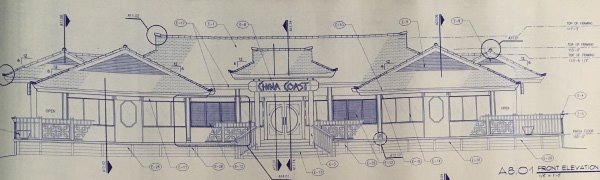
After meeting Geoff, the four of us settled into the apartment that would be our home for the next few weeks. After dinner with Larry, Shane, and Mark, I cleared the dining room table and rolled out the China Coast blueprints to begin planning our first day on the job.
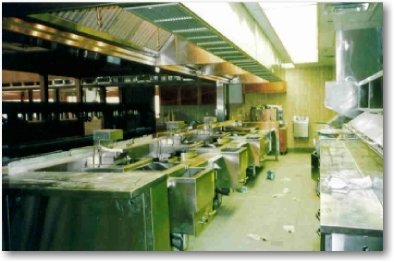
As relatively small construction projects go, building a restaurant can be abstruse because of the complex framing required for plumbing, electrical, gas, stoves, ovens, fry pots, walk-in coolers, HVAC, and other specialized commercial restaurant equipment - you have to study how each piece of machinery attaches to the walls so that you can prepare the underlying structure with the necessary wood blocking before the sheet-rockers go to work.
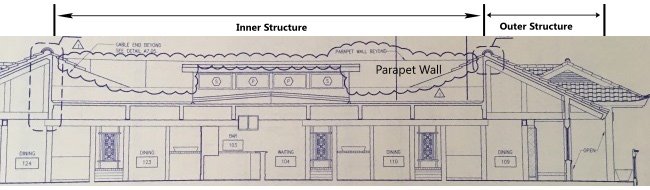
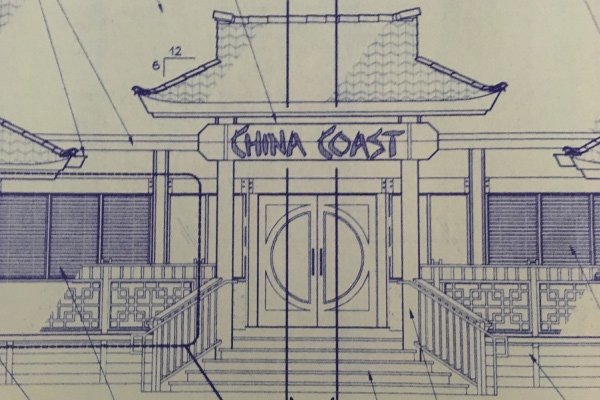
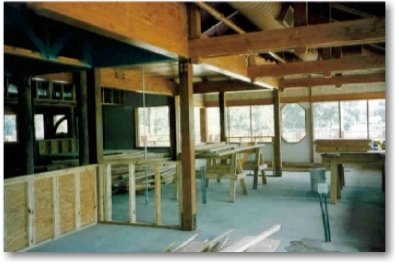
This restaurant's wood and metal structure was a box-inside-of-a-box design - an inner and an outer structure. The roof over the inside structure had a slight pitch for drainage, but was almost flat, and was used to store the HVAC equipment. Parapet walls extended above the flat roof perimeter to conceal the equipment and support the 6-12 pitch roof covering three sides of the building. The 6-12 framing tied the two structures together.
We built the restaurant's walls and beams using standard framing lumber, 2x10 pine beams, 6x6 cedar posts, 2x12 cedar planks, 6-inch diameter rough-sawn columns, and a myriad of various-sized laminated beams.
During the first week on the job, Larry and I hired the rest of the carpenters and helpers we needed using the same plywood-sign technique Daryl used in Corpus.
Mark, who had worked for Larry for more than a year before me, was discontented and resentful that Larry chose me as the foreman. I had years of experience, but Mark had seniority with Larry. Because of this, I knew Mark would be hard to manage and would resent me for being his boss, so I let him pick the work he wanted to do and left him alone. Mark became our forklift driver. He spent each day hauling materials from the back of the job site to the restaurant. It was a waste of his carpentry skills, but the job was necessary, and I didn't have the time to do it myself.
After a few weeks of spending every waking moment working and living with Larry, Shane, and Mark, I found an apartment a few miles away from the China Coast in the same complex where Geoff (who was actually from Orlando) was also temporarily living. Tammy soon joined me from Houston, and my home life returned to normal as she turned our small apartment into a comfortable transitory home.
A Typical Day at the China Coast
My workday began at 6:00 am. I left our apartment with a sack lunch and a thermos full of coffee and turned on the radio in my pickup truck in time to catch the morning traffic report, "An alligator was spotted crossing the road near Busch Blvd and 22nd Street." Alligators on the road in Florida were as common as traffic accidents.
Barring reptilian roadblocks, I usually arrived on the job site at about 6:30 am. I rarely saw anyone on-site at that hour. It was a peaceful time at the China Coast - the sweet smell of pine and new construction was strong in the calm morning air. I filled my coffee cup from my thermos, lit a cigarette, and wandered around the project to check on the progress and quality of each team's work.
Matching the day's tasks with the crew's various skills and coordinating their efforts around the other subcontractors was onerous and more demanding than I thought it would be. I split up our fifteen-person carpentry staff into carpenter/helper teams (two carpenters/one helper), except for one guy, a 65-year-old French-Canadian super-carpenter named BB. He could build just about anything and rarely came to me for help. I paired him with a strong, young, eager carpenter's helper and told him to make the helper do all the lifting and toting.
Each team had a lead carpenter whose responsibility was to ensure the work was implemented as indicated on the blueprints and to consult me if any questions arose. Shane and I had teams, also. We took the more complex tasks since we already had experience building two China Coast restaurants.
At 7 am, when the crew arrived, we rolled out the tools in preparation for a hectic day. That was when I would get the most questions. "Matt, can you come and look at this?" "Matt, what size are the windows in the men's restroom?" "Matt, we need some more plywood!" "Matt, Geoff is looking for you." "Matt, Do you have an extra hammer?" Mornings were extremely chaotic until the workers got organized and settled into work mode. Wait a minute! I thought. There ARE NO WINDOWS in the men's room!
Around mid-morning, Larry would arrive with take-out breakfast for Geoff and me. The three of us would talk about the progress, labor costs, supplies needed, and what we were planning for dinner that evening (we out-of-town folks hung out like family in the off hours). Larry was fond of rare steaks. "Tear the horns off and bring it on!" he would say to the wait staff. One day, the restaurant didn't even bother to "tear the horns off," and the steak came out cold and blue in the middle. After that day, Larry had to change his tune when ordering steaks.
Throughout the day, I visited each crew to check on their progress. Sometimes I noticed incorrect work and asked the lead carpenters questions that helped them catch their own mistakes.
During lunch hour, the crew would find shade inside the building and enjoy a sack lunch. One of the last carpenters I hired was an older gentleman from Boston. I asked him how much he wanted to get paid. "At de end o de day, eeya don't like my wook, ya don't gotta pay me nut'n." he said. I hired him, of course. He turned out to be a great carpenter and fun to work with. He had an exceptional memory for old jokes and could rattle them off one after another until someone (not always me) would finally say, "Okay now, time to get back to work!"
One morning, while standing in one of the unfinished dining areas talking to Geoff, a loud THUD suddenly shook the ground and building. The sound startled all of the workers and halted construction. Not far from us, we saw the forklift, with forks fully extended, lying on its side like a dead Tyrannosaurus Rex. We ran to see if Mark was hurt, but by the time we got to him, he had already escaped the dinosaur's cockpit. Unsafe hauling practices caused the accident. Mark was terrified but was uninjured. We guided him into the job shack and sat him in a comfortable chair. "This accident will be costly and is going to require a drug test," Geoff said to Mark. "You have two options: take the test or quit." Mark chose to quit, and the next day, he was gone. Geoff and I were not sad to see him go.
As foreman on the China Coast project, things settled down in the second half of the day, and I could return to carpentry work to help push the project along. The afternoon heat, combined with high Florida humidity, made working conditions unbearable, and tempers sometimes flared as heat and fatigue began to overcome sanity. I thought working with my fellow carpenters in the late-day heat would improve the overall mood of the crew rather than have them see me retreat to the air-conditioned job shack every afternoon.
Since I moved out of Larry's apartment, I was no longer a part of the off-work conversations between Larry and Shane. I was not there to intervene when their heated moods locked horns. Mark wouldn't have been much help, but he wasn't there either. Larry and Shane spent the long, unhappy days together, miles from their families in Houston, longing to return home. One day, Shane showed up to work with a black eye. No one needed to ask how he got that.
Geoff was the best project superintendent I had ever worked with. He was always on top of things. It became a game between us to catch each other on a detail we might have missed or hadn't thought about. "Baby-changing stations!" I thought out loud. "No way Geoff has thought of these!" Geoff better order them now, or we won't have them in time for opening day, I thought. I trotted across the parking lot, opened the door to the job shack, and saw Geoff sitting in his chair.
"Hey Geoff, have you thought about the baby-changing stations?" I asked.
He slowly pointed to a box in the corner of the room and yelled, with his scratchy voice, "They're right over there!"
We both chuckled.
"You thought you had me, didn't you, Mo-Fo!" he said while laughing hard.
"Wait until next time, Geoff!" I said as I left the job shack.
I think I made his day.
There are aspects of every construction project that are more interesting to build than others (I'm pretty sure installing baby-changing stations ranks low). Routine production-like tasks such as building walls, laying a subfloor, or decking a roof might be fun for some carpenters, but for me, it is nothing but work. Fortunately, the China Coast had plenty of challenging architectural elements to keep the thinking carpenter content.
One hot sunny afternoon, with the help of BB and two helpers, I planned to start setting all of the laminated beams that formed the underlying structure of the front roof and tower. As we placed the beams, the front elevation quickly rose into the sky and began to take impressive shape. The complex arrangement of posts and beams caught the interest of some of the crew, and I welcomed them to grab a hammer and join in the fun. Numerous rafters had to be cut and installed to complete the front roof structure. The front roof had four sections: the left side, the right side, the middle, and the tower. We split up into three teams. BB and I took the middle roof/tower. And the two other teams took the side roofs. A cloud moved in and temporarily blocked the sun, which kicked up a much-welcomed breeze. We worked fast and efficiently, cutting and installing rafters at top speed, barn-raising-party-style, while the helpers cheerfully struggled to keep us supplied with material. We completed the structure by the end of the day, and the crew was on top of the world. We had made remarkable achievements and were proud of our work. It was a great day building the China Coast!
On all of my favorite construction projects of the past, the foreman would buy beer for the crew at the end of the day. I honored this fine tradition whenever possible and always looked forward to enjoying a few brews with our worthy carpenters. Most of the guys drank Budweiser, but I preferred Milwaukee's Best. Even though the guys gave me a hard time for drinking "The Beast," I would make a cheerful spectacle of my effort to dig to the bottom of the ice chest, past a sea of Budweiser, to get my hands on the last Beast!
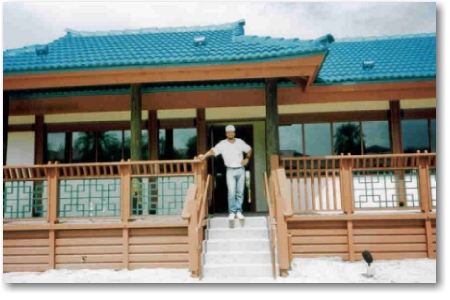
One hot afternoon, Geoff stormed out of the job shack, "Everyone, stop what you are doing!" In an instant, the job was over. The owners had decided to shut down the 50+ national restaurant chain. The entire crew was shocked - we still had at least a month of work left! A few minutes after Geoff gave us the news, an 18-wheeler arrived pulling a flatbed trailer with a large 'China Coast' sign strapped to it. Geoff refused the delivery before the driver could exit his vehicle. It was sad watching the sign slowly vanish down the road. It would have been the cherry on top of our weeks of hard work. Larry informed the carpenters we had hired that there was no more work, and they were gone.
Larry and Shane seemed pleased by the news and returned to their apartment to pack their stuff and left Tampa for Houston the next day. BB and I worked with Geoff on the job for another week to help secure the building. It was a quiet and eerie week without all the subcontractors on site.
The project ended sooner than I expected (or wanted), but after a quick evaluation, I realized I had achieved my objective in Tampa, and it was time for Tammy and me to head back to Texas to move on to the next phase of our lives. At the end of the last week, we said our goodbyes to Geoff and BB and left the China Coast for the last time.
It has been over 25 years now. I ended up in central Texas (as planned) and eventually became a programmer and cybersecurity engineer. Although the China Coast restaurant chain was a failure for the owners, it was a life-changing event for me that I will never forget.
I've lost track of all of the people I met and knew during my short time working in Corpus Christi, Dayton, and Tampa, but I hope they all learned something valuable, are living happy lives, and have fond memories, as I have, while building the China Coast.
~ Matt
What next?
Visit our home page - Check out the DYI carpentry resources on mycarpentry.com.
About the Carpenter - Read about the carpenter behind mycarpentry.com.

